
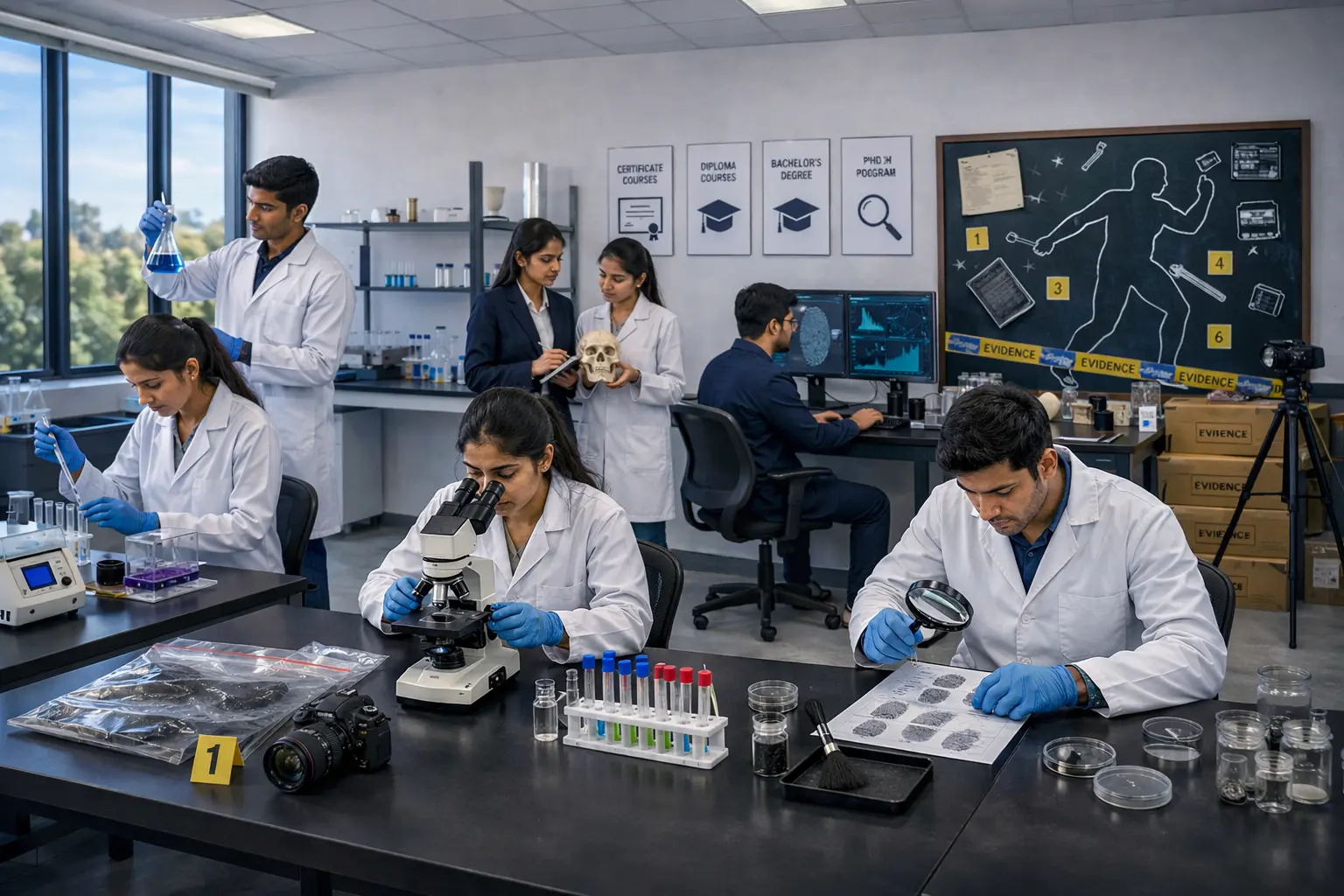

A Diploma in Forensic Science after 12th is an entry level program designed for students who have completed their 10+2 education with a science background. A PG Diploma in Forensic Science is meant for graduates who already hold a bachelor’s degree and want to specialise in advanced forensic areas. PG diploma programs generally provide better career opportunities, specialised technical knowledge, and access to higher level forensic roles.
Admissions Open for September 2026 Intake - Limited Seats
Allied Healthcare
Diploma in Forensic Science: Course Details, Eligibility, Salary, Jobs and Career Scope in India
May 28th , 2026
If you are a science student fascinated by crime investigation, evidence analysis, and the scientific techniques used to solve criminal cases, then a diploma in forensic science can be an ideal career option. In India, the demand for trained forensic professionals is increasing rapidly, making forensic science diploma courses among the fastest ways to enter this field after completing 12th or graduation.
A diploma in forensic science helps students understand important areas such as crime scene investigation, forensic biology, toxicology, fingerprint analysis, criminology, and laboratory procedures. The course combines scientific knowledge with practical training to prepare students for careers in forensic laboratories, investigation departments, healthcare institutions, and legal support services.
Whether you want to pursue a skill-focused diploma program after school or a specialised postgraduate diploma after graduation, this guide covers everything you need to know about forensic science diploma courses, including course details, eligibility, fees, syllabus, salary, job opportunities, and career scope in India.
What is a Diploma in Forensic Science?
p>A diploma in forensic science is a specialised skill-based program that trains students in the scientific methods and techniques used to investigate crimes, analyse evidence, and support the criminal justice system. Compared to a full degree program, a diploma course is shorter, more affordable, and focused on developing practical skills for faster career entry.
Forensic science diploma course details may vary depending on the course level and specialisation. The program generally covers subjects such as crime scene investigation, forensic biology, toxicology, fingerprint analysis, criminology, document examination, and digital forensics. Students gain both theoretical knowledge and practical laboratory training required for careers in forensic and investigation-related fields.
Start Your Medical Career with Diploma in Forensic Science from Top Universities - 100% Placement Support - Admissions are Open for 2026 Batch


Types of Forensic Science Diploma in India
There are several types of diploma programs in forensic science available in India, ranging from entry-level diploma courses after 12th to specialised postgraduate diploma programs after graduation. Here is a complete overview of the major diploma-level forensic science courses available in India.
-
Diploma in Forensic Science After 12th
This is an entry level diploma in forensic science for students who have completed their 10+2 education with a science background. The course is usually one year in duration and is suitable for students who want to gain basic knowledge and practical exposure to forensic science before pursuing a full degree program. If you want to explore all available forensic science courses after 12th, including degree and certificate options, check our detailed guide.
-
Diploma in Fingerprint Examination
This specialised diploma focuses on fingerprint science, identification techniques, and analysis methods used in criminal investigations. The course is available after 12th grade and generally lasts between 6 months and 1 year. It is suitable for students interested in working with police departments, investigation agencies, and forensic laboratories.
-
Diploma in Document Examination
This diploma focuses on the scientific examination and verification of documents, handwriting analysis, forgery detection, and questioned document techniques. The duration is generally six months to one year and is suitable for students interested in careers in legal and forensic document analysis.
-
Diploma in Forensic Medicine and Toxicology
This diploma is designed for students interested in the connection between medicine and the legal system. The program covers medico legal procedures, forensic pathology basics, toxicology, cause of death analysis, and clinical forensic practices. The course is usually one year in duration.
-
Advanced Diploma in Forensic Sciences and Criminology
This program combines forensic science with criminology, criminal psychology, and studies of the criminal justice system. It is more detailed than a basic diploma course and generally runs for one to two years. Students learn about criminal behaviour, crime investigation methods, forensic procedures, and legal aspects of criminal justice.
-
PG Diploma in Forensic Science
A PG diploma in forensic science is designed for students who already hold a BSc or a related degree and want to gain advanced knowledge in specialised areas of forensic science. The course is usually one year in duration and prepares students for specialised forensic and laboratory roles.
-
PG Diploma in Cyber Crime Investigation and Computer Forensics
This postgraduate diploma focuses on cybercrime investigation, digital evidence recovery, cyber laws, and computer forensic techniques. It is ideal for graduates from science, computer science, or information technology backgrounds who want to build careers in digital forensics.
-
PG Diploma in Forensic Psychology
This specialised postgraduate diploma combines psychology and forensic science. Students learn about criminal behaviour analysis, psychological assessment, victim psychology, and the role of psychology in criminal investigations and judicial processes. The course is generally one year in duration.
-
PG Diploma in Legal and Forensic Sciences
This program combines law and forensic science by covering evidence laws, medico legal procedures, criminal procedure codes, and forensic investigation methods used in legal settings. It is suitable for graduates from law or science backgrounds.
-
PG Diploma in Criminology and Forensic Science
This program integrates criminology and forensic science to help students understand criminal behaviour, crime scene investigation, and justice system procedures. The course is generally one year in duration and is offered by several universities in India.
-
PG Diploma in Forensic Toxicology
This specialised diploma focuses on toxic substances, poison analysis, drug testing, and forensic toxicology procedures used in criminal investigations. Students learn analytical toxicology methods, forensic reporting, and laboratory testing techniques. It is best suited for students with backgrounds in chemistry or life sciences.
Forensic Science Diploma Course Details Overview
| Course Details | Diploma After 12th | PG Diploma After Graduation |
|---|---|---|
| Duration | 1 Year | 1 Year |
| Eligibility | 10+2 with Science and minimum 50% marks | BSc in a relevant field with minimum 50% marks |
| Training Pattern | Classroom learning and laboratory sessions | Classroom learning, laboratory training, and research work |
| Course Focus | Crime scene investigation, fingerprint analysis, toxicology, criminology, and forensic biology | Digital forensics, forensic medicine, forensic toxicology, and specialised forensic techniques |
| Career Area | Forensic laboratories, police departments, courts, and hospitals | Advanced forensic roles, forensic consulting, research organisations, and government agencies |
Start Your Medical Career with Diploma in Forensic Science from Top Universities - 100% Placement Support - Admissions are Open for 2026 Batch
Diploma in Forensic Science Course Duration
The diploma in forensic science course duration varies depending on the program level and specialisation chosen by the student. Most diploma and PG diploma courses are designed to provide both theoretical knowledge and practical laboratory training within a short period.
| Course | Duration |
|---|---|
| Diploma in Forensic Science After 12th | 1 Year |
| Diploma in Fingerprint Examination | 6 Months to 1 Year |
| Diploma in Document Examination | 6 Months to 1 Year |
| Diploma in Forensic Medicine | 1 Year |
| Advanced Diploma in Forensic Sciences and Criminology | 1 to 2 Years |
| PG Diploma in Forensic Science After Graduation | 1 Year |
| PG Diploma in Cyber Crime Investigation and Computer Forensics | 1 Year |
| PG Diploma in Forensic Psychology | 1 Year |
| PG Diploma in Legal and Forensic Sciences | 1 Year |
| PG Diploma in Criminology and Forensic Science | 1 Year |
| PG Diploma in Forensic Toxicology | 1 Year |
These programs generally include classroom learning, laboratory sessions, case study analysis, and practical training to help students develop skills required in forensic laboratories and investigation-related fields.
Diploma in Forensic Science – Scope, Jobs and Career in India
The diploma in forensic science scope in India has expanded significantly due to the increasing use of scientific investigation techniques in criminal and civil cases. Growing cybercrime, financial fraud, digital evidence investigation, and advancements in forensic technology have created a strong demand for trained forensic professionals across government agencies, laboratories, hospitals, and private organisations.
A diploma in forensic science helps students build careers in crime investigation, forensic laboratories, cybercrime investigation, medico-legal services, criminal intelligence, and research support. Students pursuing specialised PG diploma programs can also enter advanced forensic domains such as digital forensics, forensic toxicology, forensic psychology, and legal forensics.
There are several diploma in forensic science jobs available across both government and private sectors, ranging from forensic laboratory roles to cybercrime investigation positions.
Diploma in Forensic Science Government Jobs
Government organisations remain among the largest recruiters of forensic professionals in India due to job security, structured career growth, and opportunities to work on criminal investigations and scientific analysis.
Government Organisations Hiring Forensic Diploma Holders:
- Directorate of Forensic Science Services
- Central Bureau of Investigation
- Central Forensic Science Laboratories
- State Forensic Science Laboratories
- Intelligence Bureau
- State Police Departments and Crime Branches
- National Crime Records Bureau
- Narcotics Control Bureau
- Border Security Force Scientific Units
- Government Hospitals and Medico-Legal Departments
Recruitment is usually conducted through Staff Selection Commission examinations, state public service commissions, departmental recruitment, or direct institutional hiring.
Common Government Job Roles:
| Job Role | Suitable For |
|---|---|
| Forensic Laboratory Assistant | UG Diploma |
| Crime Scene Assistant | UG Diploma |
| Fingerprint Technician | UG Diploma |
| Document Examination Assistant | UG Diploma |
| Evidence Collection Assistant | UG Diploma |
| Medico-Legal Assistant | UG Diploma |
| Laboratory Technician | UG Diploma / PG Diploma |
| Toxicology Laboratory Technician | PG Diploma |
| Digital Forensics Executive | PG Diploma |
| Forensic Research Assistant | PG Diploma |
Private Sector Jobs in Forensic Science
Private sector opportunities in forensic science are growing rapidly, especially in cyber security, digital forensics, fraud investigation, insurance investigation, corporate risk management, and legal consulting.
Private Sector Recruiters:
- Cyber Security and Digital Forensics Companies
- Banks and Financial Institutions
- Corporate Compliance and Risk Management Firms
- Legal Consulting Firms
- Insurance Investigation Agencies
- Pharmaceutical and Research Laboratories
- Private Detective and Investigation Agencies
- Information Technology and Cybercrime Consulting Firms
Common Private Sector Job Roles:
| Job Role | Suitable For |
|---|---|
| Laboratory Assistant | UG Diploma |
| Investigation Support Executive | UG Diploma |
| Forensic Documentation Assistant | UG Diploma |
| Evidence Handling Assistant | UG Diploma |
| Fraud Investigation Associate | UG Diploma / PG Diploma |
| Cybercrime Investigation Executive | PG Diploma |
| Digital Forensics Executive | PG Diploma |
| Research and Laboratory Assistant | PG Diploma |
| Compliance and Risk Investigation Executive | PG Diploma |
Many students also pursue higher education such as BSc in Forensic Science , MSc Forensic Science, or specialised postgraduate certifications to improve career growth, salary potential, and access to senior forensic roles in India and abroad.
Diploma in Forensic Science Salary
The diploma in forensic science salary in India depends on factors such as specialisation, technical skills, organisation type, and work experience. Freshers usually begin with laboratory, investigation support, evidence handling, or documentation related roles, while candidates with specialised PG diplomas can access higher paying opportunities in cyber forensics, toxicology, and digital investigation.
Government organisations generally provide stable salaries and long term benefits, while private companies may offer faster salary growth, especially in cybercrime and digital forensics domains.
Average Salary After Diploma in Forensic Science
| Job Role | Suitable For | Average Starting Salary | Experienced Salary |
|---|---|---|---|
| Forensic Laboratory Assistant | UG Diploma | ₹2 - ₹3 LPA | ₹4 - ₹6 LPA |
| Crime Scene Assistant | UG Diploma | ₹2 - ₹3.5 LPA | ₹5 - ₹7 LPA |
| Fingerprint Technician | UG Diploma | ₹2 - ₹3.5 LPA | ₹5 - ₹7 LPA |
| Document Examination Assistant | UG Diploma | ₹2 - ₹3 LPA | ₹4 - ₹6 LPA |
| Evidence Collection Assistant | UG Diploma | ₹2 - ₹3 LPA | ₹4 - ₹6 LPA |
| Medico Legal Assistant | UG Diploma / PG Diploma | ₹2.5 - ₹4 LPA | ₹5 - ₹8 LPA |
| Laboratory Technician | UG Diploma / PG Diploma | ₹2.5 - ₹4 LPA | ₹5 - ₹8 LPA |
| Toxicology Laboratory Technician | PG Diploma | ₹3 - ₹5 LPA | ₹6 - ₹10 LPA |
| Digital Forensics Executive | PG Diploma | ₹3.5 - ₹6 LPA | ₹8 - ₹15 LPA |
| Cybercrime Investigation Executive | PG Diploma | ₹3 - ₹5 LPA | ₹7 - ₹12 LPA |
| Fraud Investigation Associate | UG Diploma / PG Diploma | ₹3 - ₹5 LPA | ₹6 - ₹10 LPA |
| Forensic Research Assistant | PG Diploma | ₹3 - ₹5 LPA | ₹6 - ₹10 LPA |
Diploma in Forensic Science Eligibility
Understanding the diploma in forensic science eligibility criteria before applying is important for students planning a career in the forensic field. The eligibility requirements may differ slightly depending on the course level and institute.
For Diploma in Forensic Science After 12th
- Students must have completed 10+2 from a recognised board.
- A science background with Physics, Chemistry, Biology or Mathematics is generally required.
- Most institutes expect a minimum of 50% marks in Class 12.
- Some institutes may accept students from Arts or related backgrounds for specialised forensic or criminology related diploma programs, depending on the course structure.
For PG Diploma in Forensic Science
- Candidates must hold a Bachelor’s degree in Forensic Science, Life Sciences, Chemistry, Psychology, or a related field.
- Students who have completed a BSc in Forensic Science are directly eligible and have a strong advantage in PG diploma admissions.
- A minimum of 50% aggregate marks at the graduation level is usually required.
- Some universities may conduct an entrance test or a personal interview as part of the admission process.
Diploma in Forensic Science Fees
The diploma in forensic science fees in India vary depending on the institute type, course specialisation, laboratory facilities, and the practical training provided. Government colleges and central universities usually offer more affordable fee structures, while private institutes may charge higher fees for advanced infrastructure, industry exposure, internships, and placement support.
Below is the approximate fee range for popular forensic science diploma and PG diploma courses in India.
UG Level Diploma Courses Total Fees
| Course | Government Institute Total Fees | Private Institute Total Fees |
|---|---|---|
| Diploma in Forensic Science After 12th | ₹12,000 - ₹35,000 | ₹40,000 - ₹1.2 Lakhs |
| Diploma in Fingerprint Examination | ₹12,000 - ₹30,000 | ₹25,000 - ₹60,000 |
| Diploma in Document Examination | ₹12,000 - ₹30,000 | ₹30,000 - ₹70,000 |
| Diploma in Forensic Medicine and Toxicology | ₹15,000 - ₹40,000 | ₹50,000 - ₹1.2 Lakhs |
| Advanced Diploma in Forensic Sciences and Criminology | ₹15,000 - ₹50,000 | ₹45,000 - ₹1 Lakh |
PG Level Diploma Courses Total Fees
| Course | Government Institute Total Fees | Private Institute Total Fees |
|---|---|---|
| PG Diploma in Forensic Science | ₹15,000 - ₹50,000 | ₹50,000 - ₹1.5 Lakhs |
| PG Diploma in Cyber Crime Investigation and Computer Forensics | ₹20,000 - ₹60,000 | ₹50,000 - ₹1.2 Lakhs |
| PG Diploma in Forensic Psychology | ₹20,000 - ₹70,000 | ₹60,000 - ₹1.5 Lakhs |
| PG Diploma in Legal and Forensic Sciences | ₹15,000 - ₹40,000 | ₹40,000 - ₹90,000 |
| PG Diploma in Criminology and Forensic Science | ₹15,000 - ₹40,000 | ₹40,000 - ₹80,000 |
| PG Diploma in Forensic Toxicology | ₹20,000 - ₹60,000 | ₹50,000 - ₹1.2 Lakhs |
Additional charges such as admission fees, examination fees, laboratory fees, hostel fees, and study materials may vary depending on the institute. Students should always verify the latest fee structure through the official college or university website before applying.
Diploma in Forensic Science Admission Process
The admission process for a diploma in forensic science is generally simple and varies slightly from one institute to another. Most colleges follow either merit based admission or an entrance based selection process.
Here is the step-by-step admission process followed by most institutes:
- Research and shortlist institutes offering the diploma course suitable for your qualification level.
- Check the eligibility criteria and ensure you meet the academic requirements.
- Fill out the application form on the institute's website or at the admissions office.
- Submit the required documents, such as marksheets, identity proof, and passport-size photographs.
- Some institutes may conduct an entrance examination or shortlist candidates based on merit.
- Attend counselling sessions or personal interviews if required.
- Pay the course fees and complete the admission confirmation process.
Diploma in forensic science admissions in India usually begin between April and July for the academic session starting in August or September.
Diploma in Forensic Science Syllabus
The diploma in forensic science syllabus varies depending on the course level and specialisation chosen by the student. Most diploma and PG diploma programs combine theoretical learning with laboratory training, crime scene investigation techniques, case study analysis, and practical exposure.
Students study subjects related to forensic biology, toxicology, fingerprint science, criminology, cyber forensics, forensic psychology, medico-legal procedures, and criminal investigation methods. Some specialised programs also include internships, project work, and research based training.
UG Level Diploma Courses Syllabus
| Course | Semester 1 Subjects | Semester 2 Subjects |
|---|---|---|
| Diploma in Forensic Science | Introduction to Forensic Science, Criminology, Criminal Law Basics, Crime Scene Investigation, Forensic Biology, Laboratory Techniques | Forensic Toxicology, Fingerprint Science, Document Examination, Introduction to Digital Forensics, Criminal Investigation Procedures, Practical Training |
| Diploma in Fingerprint Examination | History of Fingerprints, Fingerprint Classification, Ridge Characteristics, Fingerprint Photography | Latent Fingerprint Development, Fingerprint Preservation, AFIS, Expert Opinion Writing |
| Diploma in Document Examination | Handwriting Analysis, Conventional Document Examination Techniques, Types of Documents | Detection of Forgery, Advanced Document Examination, Instrumentation, Case Studies |
| Diploma in Forensic Medicine and Toxicology | Principles of Forensic Medicine, Medical Jurisprudence, Clinical Forensic Medicine, Death Investigation | Forensic Toxicology Basics, Injury Analysis, Medico Legal Case Handling, Expert Testimony |
| Advanced Diploma in Forensic Sciences and Criminology | Criminology, Criminal Law, Fingerprint Science, Forensic Biology, Forensic Photography | Toxicology, Criminal Profiling, Computer Forensics, Investigation Techniques, Internship and Project Work |
PG Level Diploma Courses Syllabus
| Course | Semester 1 Subjects | Semester 2 Subjects |
|---|---|---|
| PG Diploma in Forensic Science | Criminal Law, Criminology, Fingerprint Science, Toxicology, Biochemistry in Forensics | DNA Profiling, Digital Forensics, Ballistics, Forensic Psychology, Dissertation |
| PG Diploma in Cyber Crime Investigation and Computer Forensics | Cyber Security, Cyber Laws, Digital Evidence, Network Security | Cyber Forensics, Mobile Device Forensics, Incident Response, Investigation Reporting |
| PG Diploma in Forensic Psychology | Criminal Behaviour, Offender Profiling, Forensic Interviewing, Psychology of Evidence | Victim Psychology, Psycholegal Evaluation, Court Procedures, Research Methods |
| PG Diploma in Legal and Forensic Sciences | Indian Evidence Act, Medico Legal Procedures, Crime Scene Management | Forensic Pathology Overview, Court Procedures, Criminal Justice System, Research Project |
| PG Diploma in Criminology and Forensic Science | Crime Theories, Criminal Psychology, Crime Scene Analysis | White Collar Crime, Cyber Crime, Rehabilitation, Dissertation |
| PG Diploma in Forensic Toxicology | Toxicology Principles, Drug Analysis, Poison Detection | Analytical Toxicology, Environmental Toxicology, Forensic Reporting |
The exact syllabus and subject structure may vary depending on the university, institute, and course specialisation. The syllabus above represents the standard curriculum followed by forensic science institutes in India.
Start Your Medical Career with Diploma in Forensic Science from Top Universities - 100% Placement Support - Admissions are Open for 2026 Batch
Final Thoughts
Every crime that gets solved, every piece of evidence presented in court, and every investigation that leads to justice begins with a trained forensic professional who chose to take the first step into this field.
That first step could be yours today.
The field of forensic science in India is growing rapidly. Forensic laboratories are expanding, criminal investigations are increasing, and organisations across the government and private sectors are actively seeking skilled forensic professionals who can contribute practical knowledge and technical expertise.
Whether you are beginning your journey after 12th or planning to specialise after graduation, a diploma in forensic science can provide a strong practical foundation to build a meaningful and rewarding career in criminal investigation and forensic analysis.
Are you ready to take that step?
If you are interested in building a career in forensic science and want guidance in choosing the right course and career path, you can explore expert counselling and career support opportunities with Emversity.
Get Free Consultation
Talk to our experts today
Related Blogs
Frequently Asked Questions (FAQs)
Common Questions About the Diploma in Forensic Science
